

Blog
What a House Can Teach You About Insurance Core Systems
Artificial Intelligence
All Lines of Business

CEO Perspectives on AI in Insurance from Peak3 Leadership
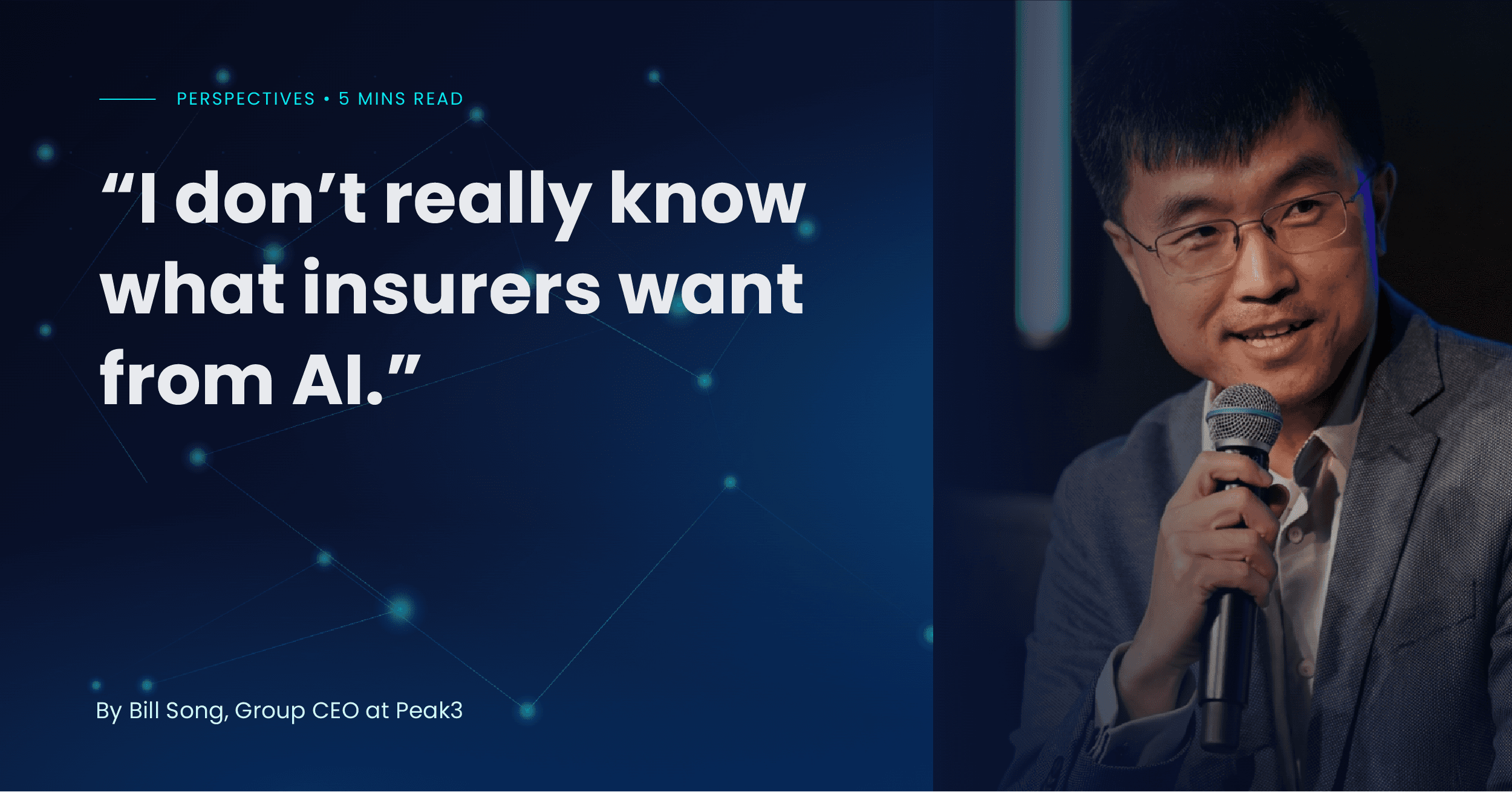
I've spent the better part of the past twelve months in conversations with insurance CEOs, CTOs and transformation leaders to discuss their AI strategies. I kept expecting a dominant pattern to emerge. It hasn’t.
To summarize four recent discussions with different insurers:
The first is an insurer belonging to a global tier 1 insurance group. They tell me they already have an enterprise AI orchestration layer in place. Their architecture is fragmented through decades of M&A and organic growth. Their strategy is to orchestrate AI centrally, on top of and across all other systems. What they want from their core systems is simple: clean and comprehensive APIs, MCP support, and sufficient performance to deal with a large number of concurrent AI agents.
The second insurer wants the opposite: AI deeply integrated into the core. Copilots for customer service and operations teams. Agents that operate natively within the underwriting and claims workbenches.
The third insurer is reasonably happy with their current core system but wants specific point solutions, like an intelligent claims-intake agent or an FWA assessor, that slot in without any replatforming program.
The fourth insurer has given up on its legacy core but also on the belief of replacing it after failed previous attempts. Instead, the discussions are now about hollowing out the legacy, capability by capability, into an agentic layer sitting above it.
Four insurers. Four strategies that can be reasonable for each of the insurer's circumstances. But no real convergence. Plus, their views and strategies continue to evolve. I can't clearly say which path is the best for each organization. Because of this, I chose the path offering the most optionality to us and to our customers.
At Peak3, we build our key agentic applications as standalone products. They run pre-integrated on top of Graphene, our core platform, so that our customers get a seamless experience. But they also deploy on top of any other core (as long as they can expose the required data and tools).
These include conversational customer service agents (such as for FNOL), intelligent document processing agents, and AI assessor and triage agents (such as for FWA identification in medical claims).
And for the insurer who just wants a modern core to build their own AI solutions on top? They can leverage our Graphene core platform as is. Graphene has been full microservices from day one. Every service can be exposed via API or MCP.
So no, I don’t know exactly what insurers want from AI or what is the best approach. What I do know is that optionality and flexibility are key competitive advantages. I rather invest more today knowing that I am ready to serve my customers whichever way the pendulum will swing.
-Bill Song, Peak3 Co-Founder and CEO
Artificial Intelligence
All Lines of Business

Core System
All Lines of Business

Artificial Intelligence
All Lines of Business