

Blog
"Modular" Is Not Microservices: Spotting a Rebranded Monolith Before You Buy One
Core System
All Lines of Business


Recently, I wrote about the three levels of AI-native insurance core systems. Based on the feedback received, my idea seems not yet fully clear to everyone. So let me use an analogy everyone is familiar with: their house.
The insurance core system is the house. What you can do in it day to day, and how easily you can change it when your needs change, is decided long before you move in. It is decided by how the house was built.
You come home, unlock the door, hang your coat where the hooks are, cook in the kitchen, sleep in the bedroom. Every one of those acts happens within the house as it was designed. The door decides how you get in. The lock decides who is allowed in. The rooms’ floorplans decide where which furniture goes. And the kitchen drawers, with their fitted dividers, decide what fits where. You are not changing the house. You are using it. The house quietly sets the boundaries of what is possible.
This is Level 1: agents that run insurance workflows on top of the core system at run-time. For example, they intake a claim, assess it, and adjudicate it. They read and write business data through the core’s tools, and only within the permissions the core grants them. The lock is authorisation, deciding which agent may enter which room and open which drawer. The appliances are the tools the AI agent can use. The layout is the ultimate guardrail, defining what an AI agent can do. And just as the dividers in a drawer fix what goes where, the core fixes how and where data can be stored, and in what form. A run-time AI agent cannot invent a new place to keep something the house has no drawer for.
Now you change the setup, not the structure. You move the furniture, turn the spare bedroom into a home office, reprogram the air conditioning schedule, swap the standard oven for a steam oven. You have not touched a load-bearing wall. But you have redefined how the house will work for you going forward.
That is the important difference from Level 1. Cooking tonight’s dinner is Level 1 (a single but repeatable event). Swapping the oven so that from now on you can steam as well as bake is Level 2, as you have changed the available tooling for all future dinners. In the core, this is design-time work: configuring the products, rates, rules and workflows that each policy then runs through. Instead of hard-coding requirements, you used to click through configuration screens. In an AI-native world, you upload a product spec in your own format or simply say what needs to change, and it gets set up.
A change at this level still needs testing, but the right kind. When you rearrange a room, you ask the people who live there whether the new layout works. Is the sofa in a sensible place? Can everyone still reach the window? You do not call in the architect or the building inspector to sign it off. A configuration change in the core is the same. You put it in front of the users to confirm it is correct and does what they intended. That is user acceptance testing. You do not need a full software testing team, or in building terms the permits and inspectors, because you have not touched the structure. Keeping that kind of change light is precisely the point of Level 2.
None of this works unless the setup is movable. If the sofa is bolted to the floor and the wardrobe is built into the wall, you cannot re-arrange a thing. In core system terms, Level 2 is only available if your products, calculations, rules and workflows live as configuration that the core can expose and an AI agent can safely change. If that logic is locked away where nothing can reach it, an agent cannot do anything.
Some things no amount of rearranging can give you. You want to knock through a wall to open up the living space, dig a pool in the garden, or add a new secured gate and fence. That changes the foundations, the flow of the whole house, sometimes its security perimeter. For this you bring in architects and licensed builders. And you do not let them start without permits, or finish without an inspection.
This is Level 3: agents that change the core itself. They write new plug-in code, build a new module, patch a vulnerability, harden the perimeter. It is software development done by multi-agent teams that span requirements, design, build and test, with human engineers moving up into review and judgment. Like any structural job, it demands the right kind of house underneath: a true microservices core with a real extension framework, a codified knowledge base, and enough construction discipline to keep AI-written code traceable and safe.
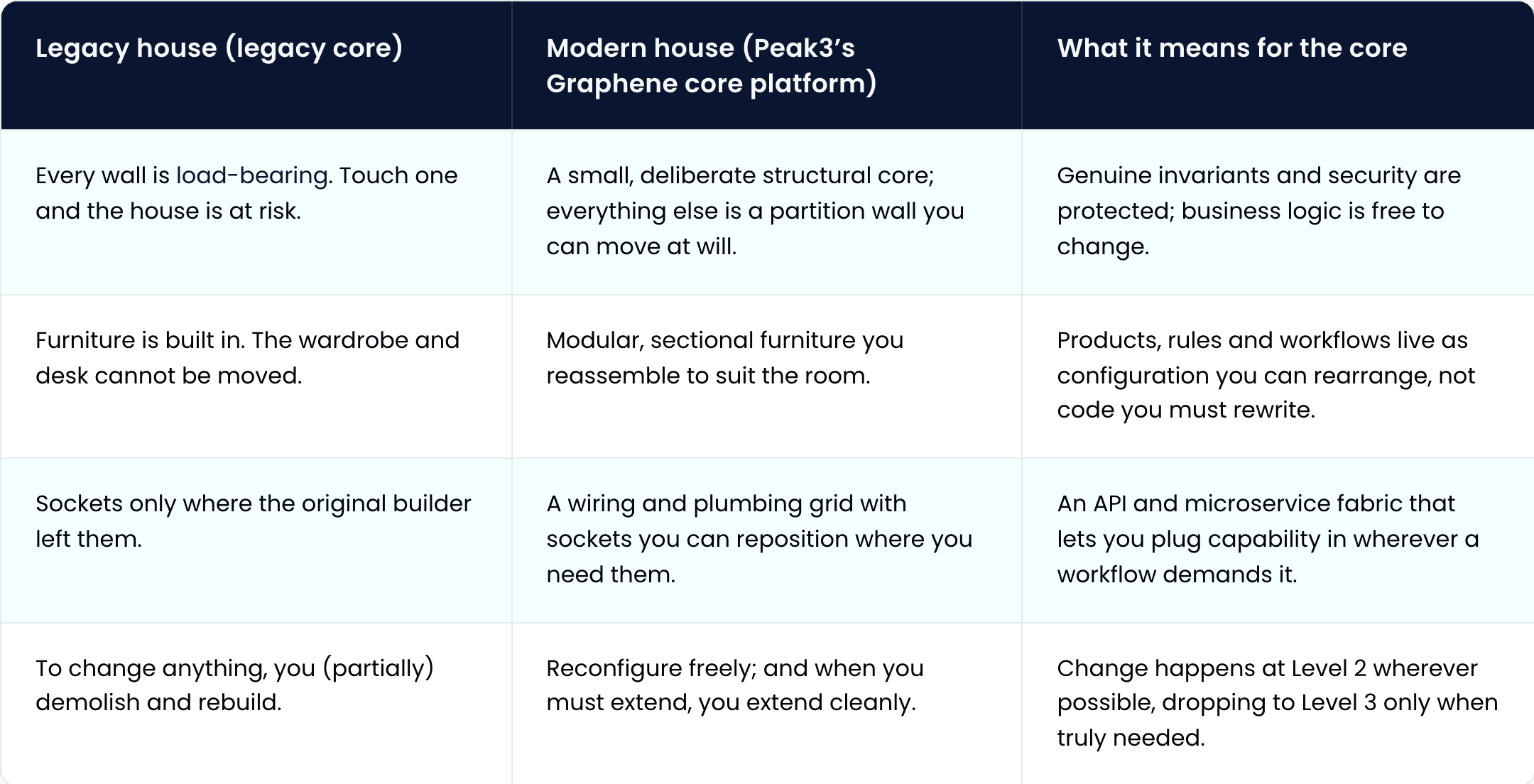
If every wall is load-bearing, if the furniture is built-in, if the sockets sit only where the original builder happened to put them, then to change anything you have to (partially) demolish and rebuild. That is legacy: minimal configurability, maximum risk. A modern core is built the opposite way.
Importantly, the same change can land on a different level depending on the house. Take the previously mentioned oven swap. In a modern, modular home it is plug-and-play. You slide the steam oven into a standard housing, connect it to a socket that was designed to be there, and it is a Level 2 job done in a morning. In an older house the oven is set into masonry, with the pipework cast into the wall behind it. Now the very same swap becomes a demolition project. It drops to Level 3: contractors, permits, weeks of work, and real risk to the rest of the kitchen or even house.
An old legacy core system does not merely make change slow. It pushes change down into the more expensive and more dangerous level. When nothing is modular, everything becomes structural. A pricing tweak that should be a five-minute rearrangement turns into a construction site. That, more than any feature list, is the real cost of a legacy core.
We are also changing how the walls go up. Not hand-laid, brick by brick, but modern, AI-assisted modular construction. It makes it faster to assemble, easier to reconfigure or extend, without giving up structural integrity or security.
New methods to develop on a lived-in house need a discipline around them. They need the building code, the permits, the inspection that let you renovate while people are still living inside. That discipline is our new AI software development lifecycle. It is what makes it safe to hand the tools to Level 3 agents.
Put the three levels together and you get the vision we are building towards: a house that renovates itself. When a new need appears, say a government launches a new tax-advantaged savings product, the house first asks whether it can simply rearrange what it already has, at Level 2. It only calls in the builders to move a wall, at Level 3, when configuration genuinely is not enough. But these builders don’t lay bricks manually but do so in a highly automated way. The permits and the final inspection are always in place.
And this is the line back to where I started. The residents, the interior fitters, and eventually the builders are all becoming AI agents. The scope of work moves from people to agents, not from the house to agents. The house matters more, not less.
Because a single-family house makes the idea tangible but undersells the reality. Insurance is not one small house. It is a large multi-residential complex. Different families live there, with different backgrounds and different needs, much like different product lines. Everyone goes about their day differently. Guests come and go, thousands of people move in and out. That demands a far stronger foundation, because now we are describing a multi-agent environment serving complex and diverging needs at the same time. The stronger the foundation, the more every AI agent is worth.
As a final note and where the analogy falls apart: historic buildings with their traditional architecture, quirks and rich history have a lot of charm. Even if the upkeep is expensive, they provide value and joy to societies. This cannot be said about legacy insurance core systems. That’s why I am on a mission to get them all modernised.
Let the house renovate itself—what a cool idea! But how do we pull this off in the real world? Peak3 already has the answer: AI DLC (the AI-driven lifecycle for evolving the insurance core) will be the bedrock for insurance companies to reinvent themselves in the next era.
Under the hood, it’s going to fundamentally reinvent how insurers operate and structure their costs. In the upcoming articles, I’ll dive deep into Peak3’s AI DLC, so stay tuned!
Core System
All Lines of Business

Artificial Intelligence
All Lines of Business

Core System
All Lines of Business